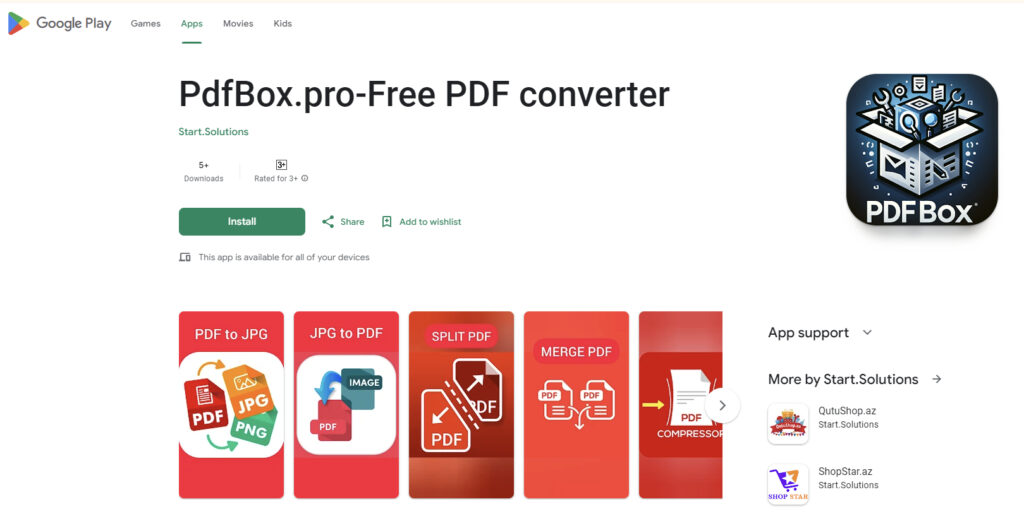
We’re thrilled to announce an exciting addition to the digital tools landscape: PDFBox App is now available for Android users! Our website has long been a trusted source for managing and converting PDF files online, and now, we’re bringing this powerful functionality directly to your smartphone.
What is PDFBox App?
PDFBox App is a mobile application designed to simplify your PDF conversion needs. With our app, Android users can now convert PDF files to various formats such as Word, Excel, PowerPoint, JPG, and more with just a few taps on their device. It embodies convenience, efficiency, and quality, all within the palm of your hand.
Features That Make a Difference
Versatile PDF Conversions: Whether you need to convert PDFs to editable Word documents for work, Excel files for data analysis, or JPG images for presentations, PDFBox App has got you covered.
User-Friendly Interface: We’ve designed our app with simplicity in mind. Its intuitive interface ensures that even first-time users can navigate through the app effortlessly.
High-Quality Outputs: Quality is paramount for us. PDFBox App ensures that your converted files maintain the highest quality, with formatting and layout preserved.
Fast and Efficient: Time is precious. That’s why PDFBox App performs conversions quickly, saving you time and hassle.
Free to Download: Get started right away without any cost. Our app is free to download on the Google Play Store, providing immediate access to powerful PDF tools.
Why PDFBox App?
In today’s fast-paced world, efficiency and convenience are key. Whether you’re a student, a professional, or anyone in need of managing PDFs on the go, PDFBox App is your go-to solution. Our app eliminates the need to rely on desktop software for PDF conversions, allowing you to handle documents directly from your mobile device anytime, anywhere.
Download Now and Transform Your PDF Experience
Ready to take your PDF management to the next level? Download PDFBox App today from the Google Play Store and experience the ultimate in convenience and efficiency.
We’re excited to hear your feedback and continue improving PDFBox App to meet your PDF conversion needs. Welcome to a world where managing PDFs is easier than ever before!
Stay Connected
Don’t miss out on updates and new features. Follow us on our social media channels and stay connected with the latest developments in PDF management technology.
For any questions or feedback, feel free to contact us. Your input is invaluable as we strive to make PDFBox App the best PDF conversion tool on the market.
In today’s digital world, where documents are shared across various platforms, the need to convert PDF files into different formats without compromising their quality is more important than ever. Whether you’re a professional working with multiple document types, a student organizing academic materials, or anyone in need of versatile document solutions, PDFBox.pro is your go-to tool. In this article, we’ll explore how this powerful online tool simplifies the process of converting PDFs to various formats while maintaining the highest quality.
Why Choose PDFBox.pro? PDFBox.pro stands out in the realm of online PDF tools for its user-friendly interface and high-quality output. Unlike many other PDF converters, PDFBox.pro ensures that the integrity of your original document is preserved, regardless of the format you’re converting to. This means no more worrying about misplaced text, distorted images, or layout changes.
Converting PDFs Made Simple: One of the key features of PDFBox.pro is its simplicity. The process of converting a PDF file into another format, such as Word, Excel, PowerPoint, or even image formats like JPG and PNG, is straightforward:
- Upload Your PDF: Start by uploading the PDF file you want to convert.
- Choose Your Format: Select the desired output format from the available options.
- Convert with a Click: Initiate the conversion process with a single click.
- Download Your File: Once the conversion is complete, download your new file in the chosen format.
Quality Assurance: At PDFBox.pro, we understand the importance of maintaining the quality of your documents. Our advanced conversion technology ensures that the formatting, images, and text in your original PDF are replicated accurately in the new format. This high fidelity conversion means you can confidently use your new documents just as you would the original PDFs.
Versatility and Accessibility: PDFBox.pro is not just about converting PDFs to other formats; it’s also incredibly versatile. Whether you need to merge PDFs, split them into separate pages, compress them for easier sharing, or even protect them with passwords, PDFBox.pro has you covered. Plus, being an online tool, it’s accessible from anywhere, on any device with an internet connection.
Conclusion: In summary, PDFBox.pro is an indispensable tool for anyone who regularly works with PDFs. Its ability to convert PDFs to various formats without losing quality, combined with its ease of use and versatility, makes it a top choice for professionals, students, and everyday users. Try PDFBox.pro today and experience the hassle-free way of handling PDF conversions!
As we delve deeper into the digital age, the way we handle documents continues to evolve. The Portable Document Format (PDF) has been a cornerstone of digital documentation for decades, known for its versatility and reliability. However, as technology advances, so do the capabilities and expectations surrounding PDFs and digital documentation. In this article, we’ll explore the upcoming trends and technologies that are shaping the future of PDFs and digital document management.
1. Enhanced Interactivity and Multimedia Integration: The future of PDFs lies in interactivity. Imagine PDFs that include embedded video content, interactive forms, and even animations. This multimedia integration will transform PDFs from static documents into dynamic, engaging experiences. This not only enhances the user experience but also opens up new avenues for creators to communicate information more effectively.
2. Improved Accessibility Features: Accessibility in digital documentation is becoming increasingly important. Future advancements in PDF technology will focus on enhancing features that make documents more accessible to individuals with disabilities. This includes improved screen reader compatibility, better text-to-speech functions, and more intuitive navigation within documents, ensuring that PDFs are accessible to all users.
3. Advanced Security Protocols: As cyber threats continue to evolve, so must the security protocols for digital documents. We can anticipate more sophisticated encryption methods and digital signatures in PDFs, providing enhanced protection for sensitive information. This is particularly crucial for industries that handle confidential data, such as finance, healthcare, and government sectors.
4. Cloud-based Collaboration and Editing: The trend towards cloud-based solutions is impacting how we interact with PDFs. Future PDF tools will likely offer more robust options for real-time collaboration and editing, similar to what we see in platforms like Google Docs. This means multiple users can view, comment on, and edit a PDF simultaneously from different locations, greatly enhancing teamwork and productivity.
5. AI and Machine Learning Integration: Artificial Intelligence (AI) and Machine Learning (ML) are set to revolutionize PDF management. Imagine AI-powered PDFs that can automatically organize and categorize themselves based on content, or offer smart suggestions for editing and formatting. Machine learning algorithms could also enable advanced data extraction and analysis from PDF documents, unlocking new insights from previously static data.
6. Environmental Impact and Digital Sustainability: As global environmental concerns grow, digital sustainability will become a more prominent consideration. The future of PDFs might involve ‘greener’ practices in digital document management, such as optimizing file sizes to reduce energy consumption during data storage and transfer, or promoting
digital document use to reduce paper waste. Emphasizing the environmental benefits of PDFs and digital documentation can play a key role in corporate sustainability strategies.
7. Virtual and Augmented Reality Integration: The integration of Virtual Reality (VR) and Augmented Reality (AR) technologies with PDFs could redefine the concept of a document. Imagine being able to step into a PDF report and interact with data in a three-dimensional space, or using AR to bring elements of a PDF to life in a real-world context. This could revolutionize fields like education, engineering, and design.
8. Mobile Optimization: With the increasing reliance on mobile devices, PDFs will need to be more mobile-friendly. This includes better optimization for viewing and editing PDFs on smartphones and tablets, as well as integrating with mobile-specific features like touch gestures and voice commands.
9. Evolving Standards and Compliance: As digital documentation becomes more complex, so will the standards and regulations governing them. Future PDFs will need to comply with evolving international standards, ensuring compatibility and security across different platforms and regions.
Conclusion: The future of PDFs and digital documentation is both exciting and dynamic. As we look ahead, it’s clear that PDFs will continue to play a vital role in our digital lives, evolving with new technologies and trends to meet the changing needs of users. From enhanced interactivity to improved security and accessibility, the next generation of PDFs promises to be more powerful and user-friendly than ever before.
Introduction Welcome to the world of PDF editing! Whether you’re a student, professional, or just someone looking to manage digital documents, understanding how to efficiently edit PDFs is crucial. In this post, we’ll explore ten essential tips to help beginners navigate the world of PDF editing with ease.
1. Choosing the Right PDF Editor Start by selecting a PDF editor that suits your needs. There are both free and paid options available, each offering different features. Consider what you need: basic text editing, image insertion, or more advanced functions like OCR (Optical Character Recognition)?
2. Learning Basic Navigation Familiarize yourself with the basic layout of your chosen PDF editor. Understand where to find key functions like adding text, inserting images, or modifying existing content.
3. Understanding Text Editing Editing text in a PDF can be different from a word processor. Learn how to add, delete, and format text. Pay attention to font types and sizes to maintain consistency throughout the document.
4. Working with Images Adding images can enhance your PDF. Learn how to insert, resize, and position images correctly without disrupting the document’s layout.
5. Utilizing Annotation Tools Annotation tools like highlighting, adding notes, or drawing shapes are crucial for reviewing or marking up PDFs. These tools are especially useful for collaborative projects.
6. Mastering Page Management Understand how to rearrange, delete, or add pages. This skill is essential for managing multi-page documents.
7. Using Bookmarks For longer PDFs, using bookmarks helps in navigating through the document. Learn how to add and edit bookmarks for easy reference.
8. Protecting Your PDFs Security is key. Learn how to password-protect your PDFs, especially if they contain sensitive information.
9. Optimizing File Size Large PDF files can be cumbersome. Learn how to compress PDFs while maintaining quality, making them easier to share and upload.
10. Exploring Advanced Features As you become more comfortable, explore advanced features like form creation, digital signatures, and Bates numbering. These features can significantly enhance your PDF editing capabilities.
PDF editing doesn’t have to be daunting for beginners. By mastering these ten tips, you’ll be well on your way to becoming proficient in managing and editing your digital documents. Embrace the process and enjoy the journey into the world of PDFs!
PDF files have become an integral part of our digital lives, offering a convenient way to share and store documents. Whether you need to merge multiple PDFs into one, convert a PDF to a different format, or split a large PDF into smaller files, there are various operations you can perform to manage your PDFs effectively. In this article, we will explore some of the most common PDF file operations and how you can accomplish them.
Merging PDF Files
Merging multiple PDF files into a single document can be useful when you have several related documents that you want to combine. There are several online tools and software available that allow you to merge PDF files effortlessly. Simply upload the PDF files you want to merge, arrange them in the desired order, and click on the merge button. The resulting merged PDF will contain all the pages from the individual documents.
Converting PDF Files
Converting a PDF file to a different format can be necessary when you need to edit or share the content in a more accessible format. Many online converters and software support converting PDFs to popular formats like Word, Excel, PowerPoint, or image formats such as JPEG or PNG. Simply upload the PDF file, choose the desired output format, and initiate the conversion process. Once the conversion is complete, you can download the converted file.
Splitting PDF Files
Splitting a large PDF file into smaller files can be helpful when you want to extract specific pages or sections from a document. Whether you need to separate chapters from a book or extract individual invoices from a PDF file, splitting can be done easily. Online tools and software allow you to specify the pages or ranges you want to extract, and then create separate PDF files for each selection.
Compressing PDF Files
Compressing a PDF file reduces its file size, making it easier to share via email or upload to a website. There are various compression algorithms that can be used to reduce the size of a PDF file without significantly affecting the quality of the content. Online tools and software provide options to adjust the compression level and optimize the file size according to your requirements.
Protecting PDF Files
Protecting sensitive information in a PDF file is crucial, especially when sharing it with others. Password protection and encryption are commonly used methods to secure PDF files. By setting a password, you can restrict access to the document, ensuring that only authorized individuals can open and view the content. Encryption adds an extra layer of security by encoding the file, making it unreadable without the appropriate decryption key.
Editing PDF Files
Editing a PDF file allows you to make changes to the content, such as adding or removing text, images, or annotations. While PDFs are primarily designed for viewing and preserving the layout, there are tools available that enable basic editing capabilities. These tools allow you to modify the text, insert images, highlight sections, and add comments or sticky notes to the PDF.
Conclusion
PDF file operations, such as merging, converting, splitting, compressing, protecting, and editing, offer a range of options to manage your PDF documents effectively. Whether you need to combine multiple files, convert to a different format, extract specific pages, reduce file size, secure sensitive information, or make edits, there are numerous online tools and software available to simplify these tasks. Choose the method that best suits your needs and start optimizing your PDF file management today.